
Pacitti
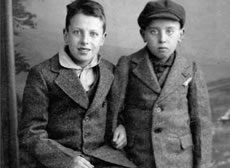
by Diane Pacitti
The Pacitti family originated in Cerasuolo, a village in the Abruzzo mountains. In the late 1890’s Antonio Pacitti emigrated to Scotland where he developed a restaurant business in Falkirk.
[spoiler name=”Family history” ]
The Pacitti family originated in Cerasuolo in the Abruzzo mountains. In the late 1890’s Antonio Pacitti the elder left this village with his future wife Letizia, from a Cassino family, to settle in Scotland. After vending ice-cream from a cart, he progressed to become a restaurant owner in Falkirk. There he shot his wife’s lover, and after a sensational court case was declared insane and eventually deported to Italy. In 1943 he was shot dead by a German officer after defying a demand to evacuate his house in Cerasuolo. Antonio had a large Scottish-born family, including his daughter Mary who worked at the Savoia café in Alloa and successfully took Rocco Forte, its owner, to court for non-payment of wages. Later, with her mother Letizia, she ran an Italian food shop in Uddingston.
Vincenzo Pacitti was the only one of Antonio’s Scottish family who was taken to Italy and brought up by an aunt in Cassino. He became a union official and socialist, and in 1928 was given a decree of exile from Cassino after a dispute with the local fascists. He fled to Glasgow with his wife and two older boys, leaving two children behind with their great-aunt in Cassino, to be reclaimed much later. Vincenzo often spoke at Glasgow Green, and housed refugees from the Spanish Civil War in the family lodgings in the Gorbals. The children grew up in severe poverty, but were gifted and resilient. Liliana became a singer who entertained the wartime troops in St. Andrew’s Halls and Raffaello (Ralph) was an outstanding snooker player who in 1977 died of a heart attack during a match with the world champion, John Spencer.
The second son, Antonio (1924- 2009) showed early artistic talent at Holyrood School and was awarded the Gold Medal for Drawing. His studies at the Glasgow School of Art were cut short by an unconventional army career which included a period in India. The destruction of Cassino by Allied bombing shocked the whole family, who were much later reunited with the aunt who was forced to leave Cassino when the Germans fortified the town. During the war the family moved to London, seeking work. Antonio studied at the Slade (1951-4) where he formed a life-long friendship with the Edinburgh-born Royal Academician Craigie Aitchison.
Antonio Pacitti went on to teach a variety of students, including life prisoners, and became a Head of Art in adult education. He continued to create art, and his solo exhibitions included Paintings, Drawings and Ceramics at the Accademia Italiana In 1999 he received the award for Graphics and Watercolours at the Malta Biennale. He was a superb draughtsman, with a drawing in the British Museum Collection. Throughout his life Antonio loved working in the medium of clay. His ceramics have been auctioned at Bonham’s and Christie, and his sculptures include a Madonna and Child at the Church of St. Thomas More, Patcham, and a Woman dancing a Prayer at All Saints, West Dulwich.
Antonio Pacitti’s life experience and his family history of displacement fed into his political works, which include the Guantanamo series of drawings which was acclaimed by Harold Pinter. The global Charter for Compassion founded by Karen Armstrong has recently featured Antonio Pacitti in its Voices Education Project, within an international listing of writers and artists who have enhanced our understanding of war.
[/spoiler]
[spoiler name=”Further resources”]
Downloads (PDF):
Antonio Pacitti exhibition : Part 1 Part 2
The Antonio Pacitti website contains more information about his work and exhibitions.
[/spoiler]