
The Italian Café in Scotland
The arrival of Italians in Scotland from the 1890s and particularly in the early twentieth century brought new products to the Scottish masses and also witnessed a bravery in retail architecture which had rarely been explored in Scotland’s small towns. The introduction of foods like flavoured sodas and ice-cream together with the Italian appreciation for architectural design meant a completely new dining experience unfolded in early twentieth century Scotland.
Background
The first Italian immigrants sold street food in the form of ice-cream from barrows in the summer and hot peas in vinegar in the winter months. Selling from these carts proved to be a difficult life and the vendors certainly experienced prejudice. The Illustrated Police News (25 August 1900) notes a case of a London baker’s boy who accused a street vendor, Francesco Porcelli, of striking him with a glass. It transpired the accused had been defending himself from boys wanting free ‘tasters’ of the ice-cream. He was released but only after the judge remarked on ‘the abominable and often poisonous nature of the so-called ice-cream vended in the streets’.
There were numerous accusations of poisoning, particularly of children, who reputedly died after consuming ice-cream from street vendors. This combined with a general suspicion of the Italians made for a hostile reception in some towns. Articles in newspapers in the Angus area seem to have been particularly vitriolic. The Arbroath Herald and Advertiser (20 November 1902) ran an article titled ‘The answer to the Italian poisoned ice-cream’. Supporting a particular Arbroath ice-cream shop, it reported on the apparent purity of local man Bloch’s ice-cream. It was claimed that the ice-cream was so pure that you could ‘feed a baby with Bloch’s ice-cream for a month and it will sustain no harm’. In a more sinister vein, the article states, ‘remember that Bloch is not an Italian. He is a citizen and a British subject’.
Permanent premises
Although the barrow selling persisted and in spite of the prejudices, many took the opportunity to open more permanent premises where they could broaden their range into other confectionery and cigarettes. Some were so successful that they opened chains of shops and the Italian ice-cream shop became a permanent fixture in Scotland.
However, controversy remained and concerns were expressed at the lack of observance of the Sabbath as many of the shops were open on a Sunday. This extended to a general disapproval of ice-cream shops as places where young people were led astray. The Arbroath Herald and Advertiser (31 May 1906) suggested the ice-cream shops were places where ‘criminal orgies’ took place. It goes on to say that young people are ‘wayward enough and wilful enough without being poisoned by the doings of foreigners who ignore the laws and customs of the country and pander to the weaknesses of youth in their efforts to make money’.
By the post Great War period there seemed to be a relaxation of attitudes to the Italians. Stirling Town Council struck a deal with Italian café owners that they could have increased Sunday opening hours as long as unregistered shops ceased. (Dundee Courier, 17 February, 1920). Six years later, the same newspaper (14 December 1926) was reporting on the extent of Italian influence in Scotland in a much more positive way under a heading ‘The Italians in Scotland’. It states ‘almost every Scottish town of any size has its quota of Italians’ going on to say that at the 1921 census there were 5230 Italians in Scotland over the age of twelve.
While some cafes celebrated their Italian owners by branding the shop with their own names (Visocchi in Blairgowrie and Nardini in Largs) others chose more neutral connections (The Ritz Cafe, Millport and Café Rex, Callander). Undoubtedly for some a name which was not Italian may have been perceived as an advantage.
Whatever the name, there is no doubting that the premises and the goods which they sold had no neutral connotations. The Italian influence in the food on offer and the setting was evident throughout and became increasingly popular across Scotland.
Marble, Mosaic, Terrazzo
The Italian immigrants to Scotland not only brought new food products but they also encouraged the use of materials which originated in their home country. Terrazzo, marble and mosaic were used widely in Italian cafes, both for interior and exterior work.
Ceramic tiling was established in the late Victorian period in shop interiors for its hygienic and aesthetic properties. Mosaic also became very fashionable in the Edwardian period, particularly for the entrance floors of retail premises. These materials, together with smooth and shiny products like Vitrolite, gained favour through the 1925 Paris Exhibition which heralded a new era in shop design as Art Deco swept through Europe. The fussy Victorian and Edwardian shopfronts gave way to minimalist designs with sleek, reflective materials and geometric inspired designs.
The ice-cream cafes widely promoted the use of particular materials and styles through their cafes. The Italian shopkeepers combined Classically inspired elegance with fashionable smooth materials whilst retaining traditional, Continental interiors with varnished timber and highly decorative features.
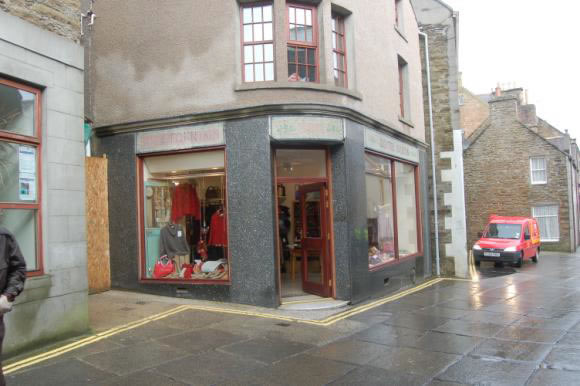
The Soda Fountain, formerly owned by the Fugaccio family in Stromness, Orkney demonstrates the use of the use of these materials. Mosaic is utilised on the fascia to form the words ‘Soda Fountain’ and ‘Coffee Saloon’. The interior is a striking example of terrazzo with the name of the owner ‘G Fugaccio’ proudly inset in the design. The shop is no longer a café but is used as a clothing retailer.
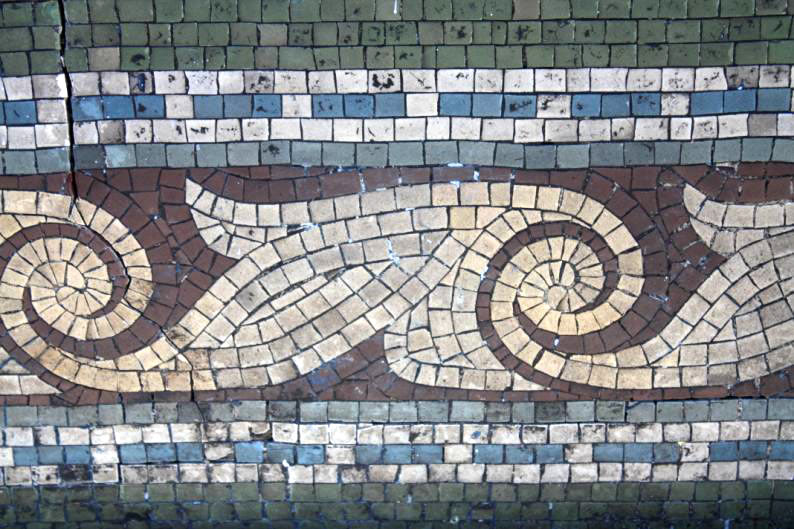


Another Scottish island, Bute also exhibits the unusual use of mosaic in its shopfronts. A number of shops in Rothesay demonstrate the use of mosaic in the stallrisers which match the entrance floors and are the only place in Scotland where these are found (Lennie, 2010). Were these designed and executed by Italian workmen? There were certainly Italians in Bute. The Post Office directory for 1900 shows that Italian confectioners such as Giuliani Leopoldi and G. Fontana had premises in Rothesay. Famously, the Zavarnoni’s also had cafes in the town and the name is still evident in Rothesay shops today.
Blairgowrie is a small town around 20 miles north of Perth located in the berryfields in the lee of the Angus and Perthshire hills. The Visocchi family first feature in the 1907-08 edition of Leslies Directory for Perth and Perthshire. Listed under ‘Confectioners’, F&F Visocchi were located in Leslie Street. According to an interview held with Mrs Jolanda Visocchi in 1992 (Laing, 2005), the Visocchi family came first to London from Italy before moving north to St Andrews, Fife in 1900 and then Blairgowrie in 1905.
The Dome Café
From their early beginnings, they expanded the business significantly in the 1920s to create a dramatic Italian café. Designed by local architects WJ Brewster and Henderson who were based at Union Bank Buildings, Blairgowrie, the ambitious design included the construction of a Dome, reputedly inspired by St Peter’s in Rome. Drawings show that the shopfront design included a variety of expensive materials including marble steps to the entrance, solid bronze grilles above the doors, oak window frames and marble cladding to the frontage (RCAHMS). Although the original drawing was specified as a marble frontage, the shop was actually clad in terrazzo, a fashionable and unassuming Interwar material.
No expense was spared in the execution of the interior. Bevelled mirrors, oak window screens and stained glass complemented the carved oak bench seating, decorative panels and embossed frieze to ceiling level.
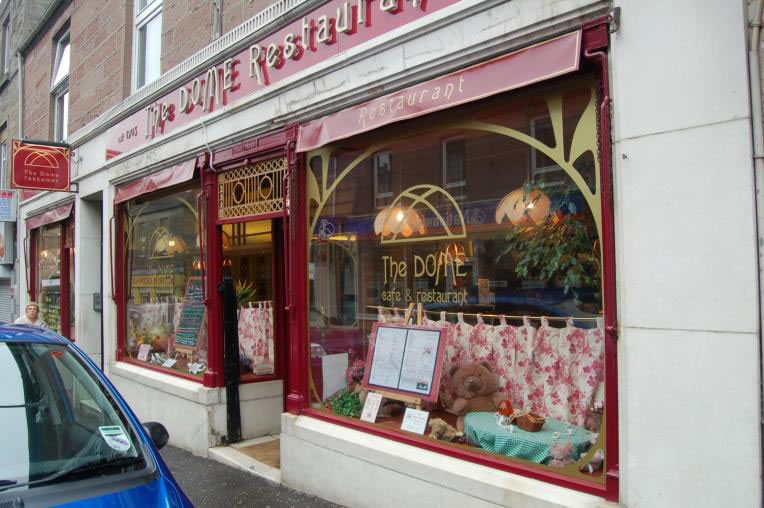
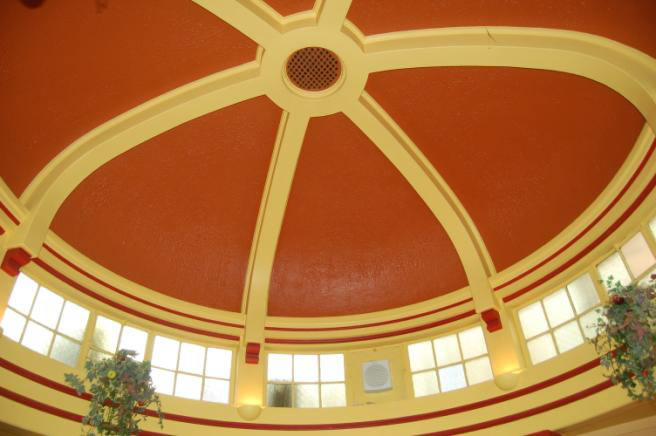
The building is Listed Category B by Historic Scotland for its fine surviving interior and impressive frontage. Although the ‘Visocchi’ lettering no longer survives, otherwise the shopfront and interior have been altered very little and as such it is a rare and important building which also has an important place in the social history of the town.
Summary
What is particularly significant about these Italian cafes is not just what they sold and the appearance of the shops but where they were located. They were not confined to the cities and large towns but instead were spread across Scotland and are found in the most remote rural areas and small towns and island communities. This geographical spread introduced the extravagance of ice-cream and sodas to communities throughout the country which must have felt other-worldly in comparison to restrained Scottish architecture. So, the smallest and most rural and remote Scottish populations benefited from Italian enterprise and stylish architectural taste.
While many Italian cafes have been altered beyond recognition, some particularly good examples such as the Dome in Blairgowrie still survive. These are evidence of the incredible contribution made by Italian café owners to Scottish retail architecture as they introduced beautiful materials and elegant designs to small Scottish communities. The legacy is a testament to the bravery of these Italian café owners.
References and Sources
- Anonymous. 25 August 1900. “An Ice-cream Merchant’s Juvenile Patrons”. Illustrated Police News.
- Anonymous. 20 November 1902. “The Answer to Italian Poisoned Ice-cream”. Arbroath Herald and Advertiser.
- Anonymous. 31 May 1906. “The Ice-cream Vendor”. Arbroath Herald and Advertiser.
- Anonymous. 17 February 1920. Dundee Courier.
- Anonymous. 14 December 1926. “The Italians in Scotland”. Dundee Courier.
- Bute County Directory 1900 to 1911. Rothesay: Higgie & Co Publishers Cohttp://www.archive.org/stream/butecountydirect190001rot#page/n33/mode/2up [Accessed 1 July 2013]
- Dictionary of Scottish Architects WJ Brewster Grant and Henderson. http://www.scottisharchitects.org.uk/architect_full.php?id=200214 [Accessed 30 June 2013]
- Historic Scotland Statutory List: HBNUM 22315 14-20 Leslie Street, The Dome Restaurant.
- Laing, Margaret (Editor). 2005. A Social History of Blairgowrie and Rattray. Blairgowrie: Blairgowrie & Rattray District Local History Trust. pp86-88.
- Lennie, Lindsay. 2010. Scotland’s Shops. Edinburgh: Historic Scotland.
- Leslies Directory for Perth & Perthshire 1907-08, Perth: Watson & Annandale.
- http://www.archive.org/stream/lesliesdirectory190708per#page/366/mode/2up [Accessed 30 June 2013]
- Royal Commission on the Ancient and historical Monuments of Scotland (RCAHMS). Drawings and photographs items B33140-B33150 and B18157-18160. Dome Café, Blairgowrie.
Biography
Lindsay Lennie is a geographer and Chartered Surveyor who has spent the last ten years researching historic shops in Scotland. She completed a PhD in 2006 with her thesis The Conservation of Historic Shopfronts in Perth and Perthshire before working for three years as a Research Fellow with Historic Scotland researching the history of retail buildings in Scotland. From this research a book, Scotland’s Shops was published.
In 2009, Lindsay set up her own consultancy, Historic Shop Conservation and she gives specialist advice on the care and conservation of traditional shops. She also provides training for public and private sector clients. See www.historicshopfronts.co.uk